Gold Plated vs. Gold Vermeil vs. Gold Fill: What Is The Difference?

When looking to purchase a piece of semi-fine jewellery there are a few different gold options available. Which is the best option for jewellery that we want to wear forever? And if not forever, what metal will hold up and stand the test of time? For me the answer used to be simple: I am allergic to any metal other than solid gold. For this reason, there was a time when I would only wear solid gold. If I wore any other metal, including sterling silver, my skin became itchy and irritated; my ears would itch wherever the metal made contact with skin. It just wasn’t worth it.

What I didn’t know at the time was that some metals like sterling silver were mixed with nickel that resulted in skin allergies and irritation. As a result I grew up a “gold snob” missing out on a huge segment of beautiful handmade and artisan jewellery made of different metals. As it turns out, the powers that be figured it out and began to phase out the use of nickel in the metals used in most semi-fine jewellery.

Of course, I was left in the dark on this until a few years ago when I started to make my own jewellery. Since I was just starting out, I decided to hone my skills using sterling silver eventually branching out to incorporate gold fill into the Marshmallow Heart repertoire. I noticed that the different metal options were generally labelled “nickel free”. I wanted to make sure that the metals I was using were not going to hurt my customers resulting in returns and headaches, so I tested them out on my own skin under the knowledge that the skin I grew up in was uber sensitive. As it turned out I was able to wear these metals without breaking out into rash or any sort of irritation, even in my ears! This was a huge revelation and opened up so many options for my jewellery designs.

What is “gold plated”?

The process of gold plating involves dipping a base metal such a stainless steel or copper into an electroplating plating solution containing solid gold resulting in an application of a thin layer of gold bonding to the metal. Generally this layer of gold is so thin that it is easily rubbed off through the process of repeated wear. It may not happen immediately, but it will happen. Sometimes labelled gold wash, gold clad, bonded gold, or plaque, to name a few, they are all just different names for plated gold jewellery all of which are a generally less expensive option to gold vermeil or gold fill jewellery.

What is “gold vermeil”?

Gold vermeil also falls into the category of plated metals. However, in the case of gold vermeil, the gold plating is applied overtop of silver, fine or sterling, and generally in a thicker application than gold plated. This means that it will take much more time for the plating to wear off. Gold vermeil is a more affordable way to own a piece that looks like gold which will remain that way for longer than gold plated jewellery, with the proper care.

What is “gold filled”?

Out of the plated metals, gold filled is considered a cut above the rest due to the fact that gold filled metals have a higher content of gold. This is why gold fill jewellery is often labelled with a karat label as to the percentage of gold present in the “fill”, such as 14K gold fill. It is created when sheets of gold alloy are permanently bonded through the application of heat and pressure to another metal such as brass or sterling silver. Due to the method of its creation, gold filled jewellery has a more permanent nature which will never lose its golden hue over years of wear, especially when cared for properly. Therefore jewellery made with this metal tends to be more expensive than its plated counterparts.

In conclusion, jewellery labelled gold plated, gold vermeil and gold filled are not considered gold jewellery. This doesn’t mean you shouldn’t buy it, but it’s important to be educated when spending money on a piece of jewellery to know exactly what you are purchasing and how long it will last. It is an affordable way to own a piece of jewellery that has the look of a gold piece without the price and with varying degress of longevity.

What is a Mala?

We all walk a different path and march to a different drum, but most people can agree that life has become fast and chaotic. We often find ourselves pulled in different directions at the same time, often working to the detriment of what we are trying to achieve in the current moment of existence. The practice of meditation has been shown to help practitioners find mental clarity and peace of mind. Many of life’s day to day stresses lose their hold on us if we find even a few moments of meditative focus each day.

Meditation has been around for roughly 5000 years, having its origins in ancient India. Various forms of meditation have also been known to originate in China and through the practices of Buddhism. The enormity of the whole picture is that you do not have to be tethered to any specific religion to meditate or practice mindfulness. Meditation is for anyone seeking a way towards righting the chaos and turning down the white noise in their individual existence.

The mala is a simple tool used to assist in the performance of meditation. A mala is a string of beads, traditionally 108, beginning and terminating at one larger bead known as the guru (teacher or master) bead.  It enables the user to keep track of the number of iterations of one’s mantra, a word or phrase repeated to help maintain concentration in meditation. The mantra is generally recited in 108 repetitions, once for each mala bead. Malas also come in 18, 27 and 54 bead lengths for shorter recitations. Malas for shorter recitations generally employ larger beads than the ones featured here.

IMG_2863
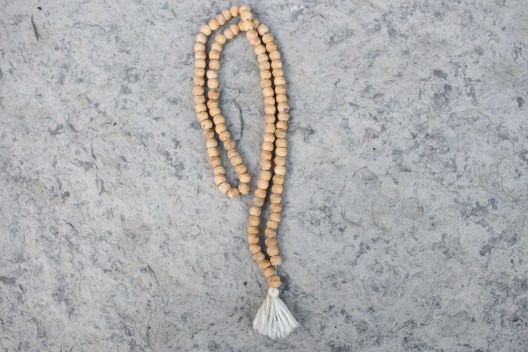
I received this 108 bead mala when I was a child. It is made with pieces of branch, handknotted on yarn. If you look closely you can see the bark on each “bead”.

At the best of times, meditation can be difficult. Sometimes when I perform my deep breathing meditation, I “wake up” following a 10 minute snooze on the rug. After one such laughable performance, my father insisted that I was so deep into it, I reached a very deep state of relaxation. Good save–this is parental encouragement at its best, especially coming from a man who attends 24 hour meditation sessions with ease! I still have a long way to go, but I keep in mind that it takes time and much practice, sometimes even a lifelong dedication, to be able to clear the mind for even the briefest of intervals. Once it is possible for a short time, the time interval can be increased slowly by a few seconds and then a few minutes at a time.

IMG_2862
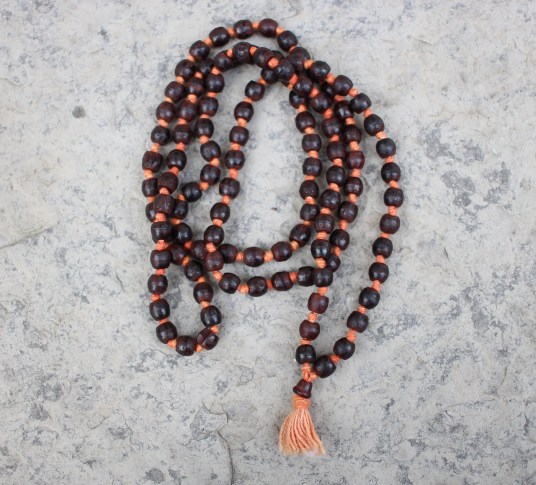
One of my mother’s malas, 108 sandalwood beads. It is not knotted between beads and is loosely strung to allow each bead to easily pass between the fingers.

To begin your meditation practice, first choose your mantra. It could be “Love”  or “Om”, or something meaningful to you that comes easily to mind and can be repeated to yourself without feeling selfconscious. My mantra is Shanti, which means peace. Sitting comfortably on the floor, loosely hold your mala in your dominant hand with

IMG_20170929_135354the first bead (after the guru bead) between your thumb and first finger. Use your thumb to guide your way through each bead on the mala as you recite your mantra.
When you reach the last bead before the guru bead, turn the mala and return back over the mala to the start. As you repeat your mantra, filling your heart with positivity, it resonates within you, helping to uplift your spirit through the power of mind focus and clarity. Alternatively, you can perform deep breathing as you work your way through your mala instead of using a mantra. Do not be discouraged or frustrated if you find yourself distracted or your mind wandering. This practice takes time and patience, and the worst thing you could do is give up. Just take a deep breath and keep going.


IMG_2981
Most of my malas were acquired from holy sites in India. They have a very organic feel with wood beads handknotted on yarn.

Finally, choosing a mala can be difficult as there is so much choice available in today’s global marketplace. Generally, you will find yourself drawn to a specific stone, pattern or material. For example I never really liked Tiger’s eye, however, when it came time to choose my mala I found myself inexplicably drawn to this stone. As well, gemstones and crystals display various healing properties and a mala can be chosen based on the desired stone properties. (For more information on healing properties of crystals and stones, see Source: Gemstone Healing Properties: Charms of Light )

IMG_2891
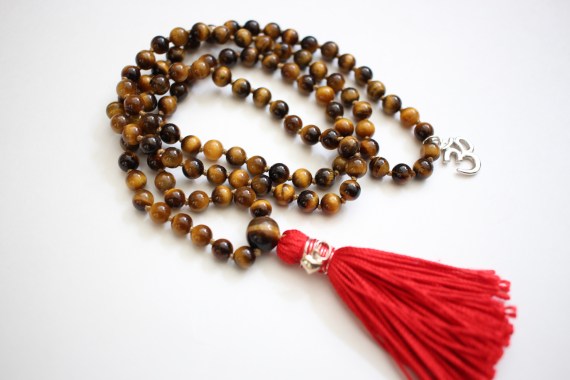
A Marshmallow Heart Creations design, this is my personal Tiger’s Eye mala.

On the other hand, it’s hard to explain, but sometimes the mala chooses the wearer. If you find yourself drawn to a mala, go with your instinct. The malas available in Marshmallow Heart Shop  include, but are not limited to the following gemstone beads:

  • Tiger’s Eye is a stone of protection, helping to focus the mind and promote mental clarity, to name a few of its properties.
  • Amethyst is revered for its ability to activate spiritual awareness and for its powerful healing and cleansing properties.
  • Labradorite is a stone of transformation and helpful during times of change, giving strength and courage to the wearer.
  • Obsidian is also a protective stone, becoming a shield against negativity and urging exploration of uncharted territory.
  • Amazonite is a soothing stone, helping to change one’s perspective by enabling the wearer to see opposing sides of the problem.(Source: Gemstone Healing Properties: Charms of Light )

Hopefully, this information is helpful to you as you begin your journey on the path towards finding peace within yourself.

Namaste.

Malas Galore!

Featured here are just a few of the mala options, currently or soon to be available through Marshmallow Heart Shop on Etsy.

All malas contain 108 beads which are knotted by hand using 6mm gemstone beads selected for their colour and gemstone properties. Most beads are shiny polished, with the exception of Amazonite, which I prefer in a matte finish to showcase the beauty of each individual stone bead. Wood beads are aromatic Cedarwood .

A gemstone mala can be heavy with 108 beads and 3″ silk tassel (wire wrapped in sterling silver) when worn all day. I use 6mm beads as I find they fit nicely between the fingers for meditation and also because the intention is that the mala be worn or kept throughout the day. This sizing makes for a beautiful piece of jewellery that doesn’t overwhelm the wearer. Your mala is a beautiful piece of jewellery, but also serves as a gentle reminder of your daily objective of self-reflection and contemplation.

All malas are handknotted using nylon thread for strength and durability but also to maintain the beautiful drape that malas are know for. Each tassel is hand made using heavier weight silk (which makes for a full bodied tassel) and wire wrapped in sterling silver with a heart charm (representing your Marshmallow Heart purchase!)

Malas hang about 18″ but length can vary depending on the length of the tassel.

Anything seen here can be reproduced with customizations as to gemstone choice, guru bead, silk tassel colour and length, or gemstone and wood bead combinations.

Enjoy and Namaste!